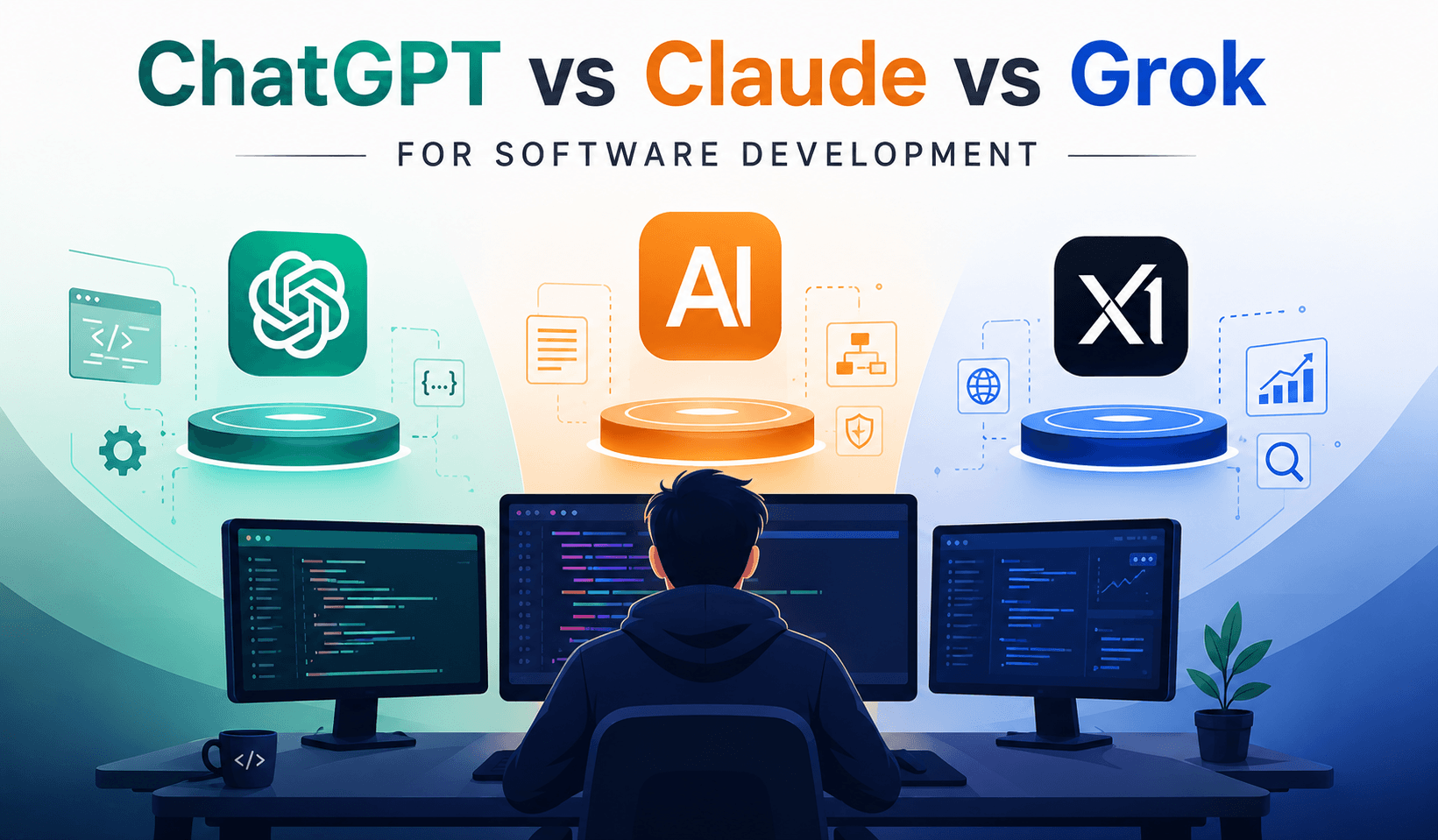
AI Software Development: ChatGPT vs Claude vs Gemini 2026

React Developer
The landscape of software engineering has shifted fundamentally from "writing code" to "orchestrating intelligence." In 2026, AI-First Development is the standard paradigm. Software developers no longer treat Large Language Models (LLMs) as simple autocompletion add-ons; they deploy them as autonomous agents, architectural partners, and complex system cross-compilers.
Choosing the right ecosystem is critical. The market has consolidated into three primary titan platforms: OpenAI's ChatGPT (powered by GPT-5 and the o-series reasoning engines), Anthropic's Claude (anchored by Claude 4.8 Opus, Sonnet 4.6, and the agentic Fable 5), and Google's Gemini (championed by Gemini 3.5 Flash and Gemini 3.1 Pro).
This comprehensive technical blueprint analyzes their performance, architectural ecosystems, agentic frameworks, and benchmarking scores to help engineering leaders, architects, and any enterprise or forward-thinking AI software development company construct the optimal stack.
1. Executive Summary & Core Paradigms
Each platform has developed a clear philosophical direction tailored to specific developer workflows.
Claude (Anthropic): The Autonomous Software Engineer. It dominates complex engineering, multi-file codebase updates, and long-horizon tasks, leading the industry on SWE-Bench metrics.
ChatGPT (OpenAI): The Generalist Workbench & Reasoning Engine. Backed by mature developer tools, multi-modal integration, and rigorous deep-thinking execution (o3/GPT-5), it provides unmatched speed and tool-switching logic.
Gemini (Google): The Data-Heavy Infinite Context Platform. Uniquely offering up to a multi-million token context window natively integrated across Google Cloud Platform (GCP) and Workspace, it is the premier platform for legacy refactoring and deep technical research.
Platform Architecture At-A-Glance
Feature/Metric | OpenAI ChatGPT (GPT-5 / o3) | Anthropic Claude (Opus 4.8 / Fable 5) | Google Gemini (3.1 Pro / 3.5 Flash) |
Primary Code Strength | Rapid ideation, data analysis, plugin/tool variety | Multi-file agentic execution, precise instruction following | Massive codebase intake, legacy migrations, GCP architecture |
Max Context Window | 128K - 200K equivalent | 200K tokens (with managed memory layers) | 1,000,000 to 2,000,000+ tokens |
Key Developer Feature | Advanced Code Interpreter, Sora/DALL-E native pipelines | Claude Code (agentic CLI), Model Context Protocol (MCP v2) | Gemini Code Assist Enterprise, Deep Research agents |
SWE-Bench Verified Score | ~65-68% | 72.7% (Industry Leader via Sonnet 4.6) | ~60-63% |
2. Deep Dive: Claude’s Engineering Supremacy
In 2026, Anthropic holds a decisive lead in real-world software engineering benchmarks. By focusing on raw logical accuracy, rigid instruction-following, and deterministic output structures, models like Claude Sonnet 4.6 and Claude Opus 4.8 minimize the hallucination cycles that plague iterative development.
Claude Code and Agentic Loops
The launch of Claude Code transformed the development ecosystem from a standard conversational UI into an interactive terminal runtime. Rather than asking a chatbot for isolated code fragments, developers run:
Bash
claude -p "Migrate our database access layer from Prisma to Drizzle and fix failing integration tests"
Claude Code initializes an automated reasoning loop using the /loop directive. It analyzes the directory structure, reads target files, runs local terminal compilation scripts, intercepts errors, and dynamically rewrites its code until the codebase passes all localized tests with a 100% success rate.
The Model Context Protocol (MCP v2)
Anthropic’s open-sourced Model Context Protocol solves the "context silo" problem. MCP acts as a secure, stateless abstraction layer bridging the model directly to specialized local databases, enterprise repositories, and enterprise APIs with zero-config glue code. Through MCP lazy loading, Claude pulls contextual project metadata just-in-time, preventing context bloat and keeping token consumption minimal during long-horizon tasks.
Enterprise Milestone: Anthropic's premium mythos-class model, Claude Fable 5, successfully migrated Stripe’s 50-million-line legacy Ruby codebase in less than 24 hours—a task originally projected to take an entire human engineering squad upwards of two months.
3. Deep Dive: ChatGPT’s Ecosystem and Reasoning Core
OpenAI's strategy centers on multi-modal dominance and multi-step computational reasoning. Powered by the o3 reasoning engine and GPT-5, ChatGPT approaches software problems by spending upfront compute to "think" before generating a single character of syntax.
Effort Control and Cognitive Processing
ChatGPT allows developers to modulate the depth of its thinking layer. For simple scripts, a low-effort mode yields lightning-fast responses. For distributed systems architecture or cryptography audits, high-effort modes trigger deep, branch-evaluating chains of thought.
[User Prompt] -> [o3 Reasoning Phase: Evaluates 5 alternate architectures] -> [Self-Correction: Avoids race condition] -> [Output Code]
This intentional latency ensures that complex multi-threaded backend services are less prone to logical deadlocks.
Advanced Code Interpreter and Tooling
ChatGPT remains unmatched in data science and algorithmic prototyping. Its integrated sandboxed Python sandbox executes code dynamically, graphs distributions, builds machine learning proofs-of-concept, and tests its own performance on the fly. Coupled with the extensive custom GPTs Marketplace, developers hook directly into hundreds of third-party developer toolchains, including API orchestrators, Jira automation scripts, and continuous integration monitors.
4. Deep Dive: Gemini’s Infinite Context and Cloud Integration
Google's Gemini 3.1 Pro and Gemini 3.5 Flash models possess a massive computational competitive advantage: a native, high-fidelity context window scaling up to 2 million tokens.
Monolithic Codebase Engineering
While ChatGPT and Claude require developers to split repositories into fragmented chunks or rely on vector databases (RAG), Gemini digests entire monorepos simultaneously.
Developers can upload an entire application architecture, complete with thousands of files of technical documentation, structural dependency graphs, and historical deployment logs, and ask:
"Where are the structural bottlenecks in our microservice communications?"
"Generate a complete end-to-end integration test coverage strategy based on our actual repository code."
Gemini Code Assist Enterprise
For enterprises heavily tied to Google Cloud Platform (GCP), Gemini is natively woven into the cloud infrastructure. Gemini Code Assist Enterprise provides deep, context-aware assistance inside IDEs like VS Code, IntelliJ, and Android Studio, pulling contextual data from Firebase, Cloud Run, and BigQuery seamlessly. It features Next Edit Prediction capabilities, tracing active typing patterns to predict multi-line edits before they are typed out manually.
5. Architectural Breakdown: Head-to-Head Scenarios
To help engineers choose their day-to-day tooling, we evaluate the platforms across distinct technical categories.
Scenario A: Greenfields App Prototyping
Winner: ChatGPT
Why: ChatGPT's rapid brainstorming, dynamic Code Interpreter sandbox, and rich multi-modal toolsets allow an engineer to go from an abstract system idea to a functional backend prototype and UI design with incredible speed.
Scenario B: Multi-File Refactoring & Autonomous Bug Fixing
Winner: Claude
Why: Claude’s 72.7% score on the SWE-Bench Verified metric shows its practical advantage. Combined with Claude Code's terminal capabilities and strict adherence to architectural system guidelines, it is the best option for deep engineering workflows.
Scenario C: Legacy Code Auditing & Large System Onboarding
Winner: Gemini
Why: No other model can intake millions of lines of active code without experiencing significant memory degradation. Gemini reads massive chunks of information cleanly, making it perfect for interpreting complex legacy systems.
6. Financial Analysis & API Costs
For development organizations looking to scale AI agents, managing API costs across input and output tokens is a significant factor.
Comparative API Token Pricing (Per Million Tokens)
Claude Fable 5 (Premium Agentic): \(10.00 Input / \)50.00 Output
Optimized for long-running, critical enterprise autonomous migrations.
Claude Sonnet 4.6 (Everyday Workhorse): \(3.00 Input / \)15.00 Output
The industry baseline for cost-to-performance efficiency.
OpenAI GPT-5 / o3 Base: \(4.00 Input / \)18.00 Output
Balanced pricing with deep reasoning logic.
Gemini 3.5 Flash: \(0.075 Input / \)0.30 Output
Extremely fast processing for high-volume, cost-sensitive automation.
7. Strategic Recommendations
The modern developer's optimal setup rarely involves selecting just a single tool. Instead, engineering teams are adopting cross-functional multi-model pipelines based on clear project goals:
Deploy Claude Pro / Claude Code as your primary IDE driver for complex, multi-file software engineering tasks, test execution, and continuous code integration loops.
Utilize Gemini Pro when onboarding engineers to large, unfamiliar codebases or when parsing massive log streams and system documentation files.
Leverage ChatGPT for high-level technical architecture design, multi-modal asset creation, data analysis pipelines, and fast algorithmic brainstorming.
8. Conclusion: Navigating the Multi-LLM Era
The paradigm shift of 2026 has made one reality abundantly clear: the question is no longer which AI model is best, but rather how to orchestrate them collectively to build resilient software. The specialization of ChatGPT, Claude, and Gemini has effectively broken the monopoly of any single provider, forcing every modern AI software development company and enterprise engineering department to adopt a multi-LLM, routing-centric architecture.
The Specialized Breakdown
When assembling your engineering stack, the selection framework can be distilled into three distinct mandates:
Choose Claude if your priority is autonomous execution, terminal-driven operations, and minimizing human intervention in multi-file engineering tasks. It remains the absolute gold standard for day-to-day code writing, test generation, and complex continuous integration (CI) workflows.
Choose ChatGPT if your team requires deep mathematical reasoning, sophisticated multi-modal asset creation, high-level structural brainstorming, and a mature ecosystem of dynamic plugins and sandboxed data-science engines.
Choose Gemini if you are tackling massive enterprise technical debt, ingesting million-token monolithic codebases, migrating legacy software, or operating natively within a deeply integrated Google Cloud Platform infrastructure.
Looking Ahead: The Autonomous Future
We are rapidly moving away from simple chat interfaces and basic autocomplete widgets. The future of software engineering belongs to agentic frameworks that leverage the raw reasoning depth of the o-series engines, the deterministic implementation precision of Claude, and the infinite memory banks of Gemini.
The Architectural Shift: True engineering efficiency in 2026 is achieved by building intelligent routing layers. By automatically directing simple scripts to low-cost models like Gemini Flash, routing deep logic problems to ChatGPT's reasoning core, and passing multi-file codebase updates to Claude Code loops, organizations can maximize software throughput while keeping operational token expenses optimized.
Ultimately, these tools are not replacing the human engineer; they are elevating the developer's role from a manual code craftsman to a high-level systems architect. The organizations that thrive in this era will be those that deeply understand the subtle nuances, strengths, and economic tradeoffs of each underlying intelligence engine, synthesizing them into a unified, high-velocity development machine.