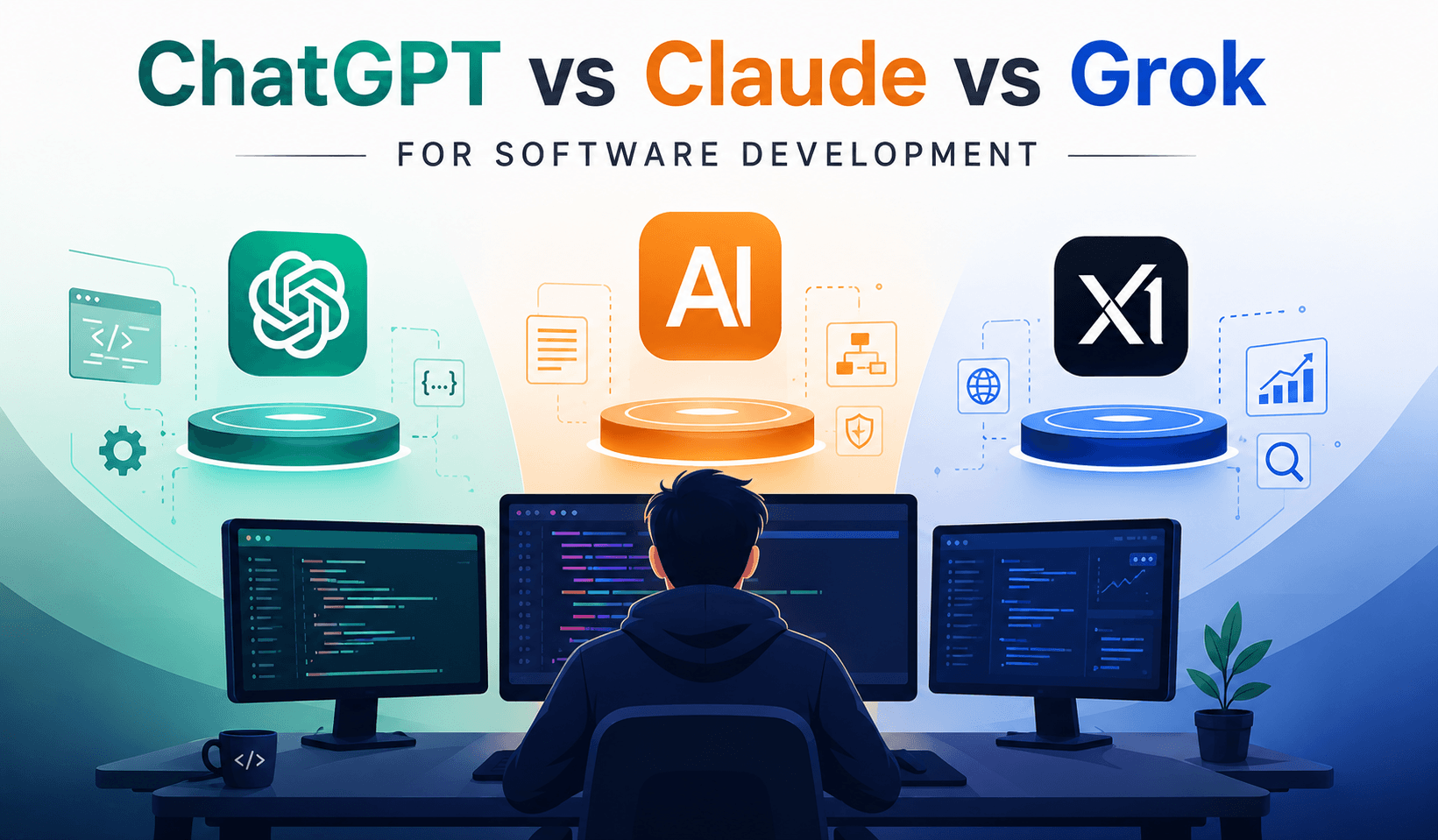
ChatGPT vs Claude vs Grok for Software Development in 2026: The Definitive Comparison
React Developer
If you're a software developer in 2026, you have more AI firepower at your fingertips than ever before — and more confusion about which tool to actually use. ChatGPT (GPT-5.5), Claude (Sonnet 4.6 / Opus 4.7), and Grok 4 are the three models dominating developer conversations this year. Each has made significant leaps. Each wins in different scenarios.
This guide cuts through the noise with benchmark data, real-world developer tooling analysis, pricing breakdowns, and a clear verdict for every major software development use case.
Quick Summary: Who Wins What {#quick-summary}
| Category | Winner | Runner-Up |
|---|---|---|
| SWE-bench (autonomous bug fixing) | Grok 4 (75%) | Claude Opus 4.7 (~74%+) |
| Developer tooling ecosystem | Claude | ChatGPT |
| Agentic coding (Claude Code, Cursor) | Claude | ChatGPT Codex |
| Speed of code generation | Grok | ChatGPT |
| API cost efficiency | Grok / ChatGPT | Claude Sonnet |
| Code documentation & explanation | Claude | ChatGPT |
| Real-time data / Stack monitoring | Grok | ChatGPT |
| Enterprise compliance & safety | Claude | ChatGPT |
The headline: no single model dominates every row. That's the defining story of AI for developers in 2026 — the gap has narrowed, and specialization has won.
Coding Benchmarks: The Numbers That Matter {#coding-benchmarks}
SWE-bench Verified is the gold standard for measuring practical coding AI capability. It tests whether a model can autonomously resolve real GitHub issues — not just write plausible-looking code, but produce code that actually passes the repository's test suite.
As of mid-2026, the leaderboard looks like this:
Grok 4: 75% SWE-bench Verified
Claude Opus 4.7: ~74%+ SWE-bench Verified; 64.3% on the harder SWE-bench Pro
Claude Sonnet 4.6: ~72.7%–75.6% SWE-bench (varies by harness), the best value in the Claude family
GPT-5.4 / GPT-5.5: ~74.9% SWE-bench Verified
These numbers are remarkably close. All three models now sit within roughly one percentage point of each other on SWE-bench Verified — a stark contrast to even 18 months ago, when Claude held a commanding lead. The benchmark harness (i.e., how the model is scaffolded to interact with code) now drives as much variance as the underlying model itself.
What hasn't converged: developer ecosystem penetration. Claude powers Cursor, Windsurf, and Claude Code — the three tools most professional developers use daily. Grok 4 leads on raw scores but lags on tooling integration. ChatGPT's Codex agent fills a specialized niche for terminal-based agentic work.
For developers asking "which AI resolves bugs best in isolation?" — Grok and Claude are essentially tied. For "which AI fits into my actual workflow?" — Claude wins by a wide margin.
Developer Tooling & IDE Integration {#developer-tooling}
The AI coding assistant space has consolidated around three major workflows in 2026:
Claude-Powered Tools (Cursor, Windsurf, Claude Code)
Claude Sonnet 4.6 is the default model behind Cursor and Windsurf, the two most widely adopted AI-native IDEs among professional developers. Claude Code — Anthropic's command-line agentic coding tool — has become a standard part of many senior engineers' toolchains. The combination of high SWE-bench performance, 128K output tokens (double any competitor), and deep tool-use integration makes Claude the dominant ecosystem player for serious development work.
ChatGPT / OpenAI Codex
GPT-5.5 is the backbone of GitHub Copilot's broader ecosystem and OpenAI's Codex agent for terminal-based workflows. Codex is purpose-built for software-development-as-an-agent: editing files, running shell commands, and debugging in live environments. If your workflow is less chat-assisted and more autonomous pipeline execution, Codex deserves serious consideration. The OpenAI ecosystem also offers the most mature third-party tool integrations of any provider — helpful for teams already embedded in the OpenAI API stack.
Grok
Grok 4's IDE and tool integrations are more limited than Claude or ChatGPT as of mid-2026. Grok Code Fast (a lighter variant) is available free on GitHub Copilot, Cursor, Cline, and Windsurf — making it a compelling zero-cost option for developers who want to experiment. Grok's four-agent architecture and 2-million-token context window are genuinely impressive on paper, but fewer production developer tools have adopted it as a primary backend.
Bottom line on tooling: Claude dominates the professional IDE ecosystem. ChatGPT dominates enterprise pipelines. Grok is a compelling free tier option but not yet the backbone of major developer tools.
Code Quality: Real-World Analysis {#code-quality}
Beyond benchmarks, developers care about what working with these models actually feels like.
Claude has a reputation for producing cleaner, more idiomatic code with better inline documentation. It catches edge cases that other models miss, and its code explanations are widely considered the clearest of any frontier model. The 128K output token limit — double any competitor — means Claude can generate entire modules or refactor large files in a single response without truncation. This is practically significant for complex systems work.
ChatGPT (GPT-5.5) is the strongest all-rounder for multimodal development tasks — combining vision (for reading UI screenshots or diagrams), code generation, file uploads, and image generation (DALL-E integration) in one interface. For developers who need to switch between code, images, and documents in a single session, GPT-5.5 Canvas offers inline commenting and version tracking that's genuinely useful. It also produces 33% fewer hallucinations than its predecessor GPT-5.2, a meaningful improvement for code reliability.
Grok 4 brings two underrated advantages to software development. First, its response speed: in coding scenarios, Grok's specialized modes can return suggestions in under 2 seconds, significantly faster than the typical 5–8 second wait for Claude on equivalent tasks. For developers in tight iteration loops, this adds up. Second, Grok's 2-million-token context window — the largest of the three — lets it ingest entire large codebases in a single prompt, which is genuinely useful for refactoring legacy systems or performing cross-codebase analysis.
Agentic Coding & Autonomous Tasks {#agentic-coding}
Agentic coding — where the AI doesn't just suggest code but autonomously plans, writes, tests, and iterates — is the most significant shift in developer workflows in 2026.
Claude is the current leader here for most developers. Claude Opus 4.7's tool-augmented reasoning and Claude Code's ability to run multi-step terminal workflows have made it the go-to for complex agentic tasks. Claude Opus 4.6 scores 1606 Elo on expert agentic tasks — far ahead of competitors on that specific benchmark. The model also reliably handles long agentic chains without losing context or coherency.
ChatGPT Codex (GPT-5.3, distinct from the general GPT-5.5) is a specialist agentic model built specifically for software development pipelines. It doesn't compete on general benchmarks but excels at terminal-native workflows: editing files, running commands, and integrating with CI/CD. For teams running autonomous code review or deployment pipelines, Codex is worth evaluating as a purpose-built alternative.
Grok 4 uses a four-agent collaborative architecture that's architecturally interesting — multiple sub-agents work together on complex tasks. Combined with its 2M token context, this makes Grok 4 theoretically strong for large-scale codebase operations. In practice, the ecosystem support for Grok 4 agentic workflows remains less mature than Claude or OpenAI.
Context Windows & Large Codebases {#context-windows}
| Model | Context Window | Output Tokens |
|---|---|---|
| Grok 4 | 2,000,000 tokens | ~32K |
| GPT-5.5 | 1,000,000 tokens | ~32K |
| Claude Opus 4.7 | 1,000,000 tokens | 128,000 |
| Claude Sonnet 4.6 | 200,000 tokens | 64,000 |
For large codebase work, Grok 4's 2M context is the theoretical leader. In practice, Claude's 128K output limit is the most practically useful differentiator — being able to generate large, complete files without truncation matters more for most development tasks than an enormous input context.
API Pricing for Teams {#api-pricing}
Pricing matters significantly at scale. Here's what teams are paying in mid-2026:
| Model | Input (per 1M tokens) | Output (per 1M tokens) |
|---|---|---|
| Claude Sonnet 4.6 | $3 | $15 |
| Claude Opus 4.7 | $15 | $75 |
| GPT-5.5 | ~$2.50 | $15 |
| Grok 4 | $2 | $15 |
Consumer plans are roughly consistent across all three: ~\(20/month for Claude Pro, \)20/month for ChatGPT Plus, and $22/month for Grok via X Premium+.
For cost-conscious teams running at scale: Grok 4's \(2/M input is the most affordable among the major closed-source frontier models. Claude Sonnet 4.6 at \)3/$15 delivers approximately 80% of Opus-tier coding performance for a fraction of the Opus price — making it the best value in the Claude family for daily development work.
Speed & Reliability {#speed-reliability}
Grok is the fastest of the three for code generation — specialized modes return suggestions in under 2 seconds for typical prompts. For developers in rapid iteration cycles, this is a genuine workflow advantage.
ChatGPT offers steady, moderate speed — typically a few seconds for most queries — with mature infrastructure that handles demand spikes well. By mid-2026, it has the largest user base (400M+ weekly active users) and correspondingly robust uptime.
Claude is stable and consistent rather than lightning-fast. Claude's infrastructure has improved significantly through 2025–2026, with load handling that's reliable for professional use. The tradeoff is thoughtful, longer outputs that prioritize quality over raw speed.
Strengths & Weaknesses Summary {#strengths-weaknesses}
ChatGPT (GPT-5.5)
Strengths: Widest ecosystem; best multimodal integration (vision, voice, image generation); most mature third-party API tooling; Codex agent for terminal workflows; fewest hallucinations among GPT models to date.
Weaknesses: Coding depth still trails Claude on SWE-bench; more expensive than Grok at equivalent capability tiers; Canvas editor useful but not best-in-class for pure code generation.
Claude (Sonnet 4.6 / Opus 4.7)
Strengths: Dominant in developer tooling (Cursor, Windsurf, Claude Code); best code quality and documentation; highest output token limit (128K); strongest agentic coding reliability; cleanest code with best edge-case coverage.
Weaknesses: Opus tier is expensive for scale API usage; slower response speed than Grok; Sonnet context window smaller than competitors' flagship models.
Grok 4
Strengths: Leads raw SWE-bench (75%); fastest response times; largest context window (2M tokens); cheapest frontier API pricing; real-time X/Twitter data integration useful for monitoring tech trends or library updates.
Weaknesses: Weakest developer tooling ecosystem; fewer production integrations; four-agent architecture is promising but less battle-tested than Claude's tool use; can produce opinionated or inconsistent outputs on ambiguous tasks.
Final Verdict: Which AI Should Developers Use? {#final-verdict}
For most professional developers: Claude Sonnet 4.6 via Cursor or Claude Code.
It's the daily driver that dominates the tools developers actually use, produces the cleanest code, and hits the best balance of performance and cost. The 128K output limit removes a major friction point for complex generation tasks.
For autonomous pipeline / agentic terminal workflows: ChatGPT Codex.
If your use case is software-development-as-an-agent in a CI/CD environment rather than chat-assisted coding, Codex is purpose-built for this and worth the OpenAI ecosystem lock-in.
For large codebase ingestion or budget-first teams: Grok 4.
The 2M token context and lowest API pricing make Grok 4 compelling for teams that need to process massive codebases or run high-volume API workloads. The free tier via GitHub Copilot also makes it a low-risk way to experiment.
For complex architectural projects: Claude Opus 4.7.
When the task is genuinely hard — multi-system refactoring, novel algorithm design, or extended agentic chains — Opus 4.7's benchmark leadership and 128K output translate to real-world advantages worth the premium.
The broader truth in 2026: most serious developers use two models, not one. Claude for daily coding and documentation; Grok or ChatGPT for specialized tasks where speed, ecosystem, or cost is the decisive factor. The era of picking one AI assistant and sticking with it is over — the smartest workflow is knowing which tool to reach for.